CAM 7/8 Science - Battle Ground Public Schools - Battle Ground, WA
The Cube
|
|
In your science journal, record the following:
1) Observations:
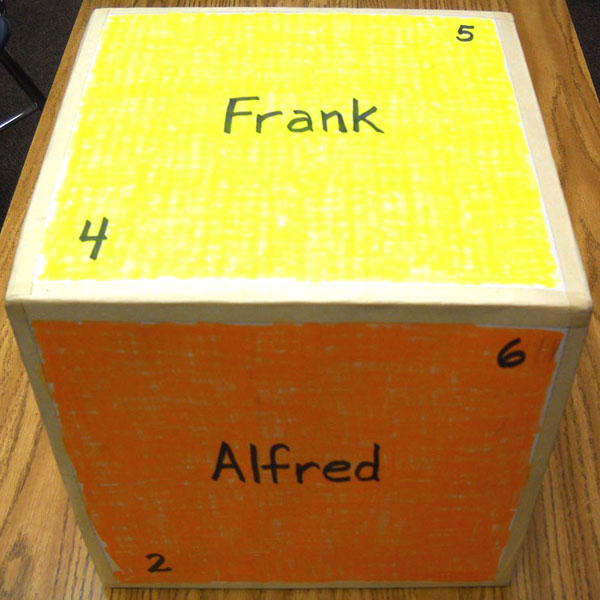
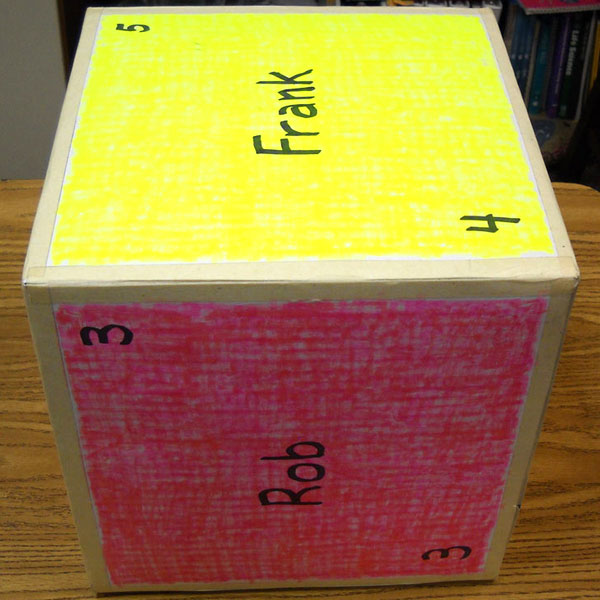
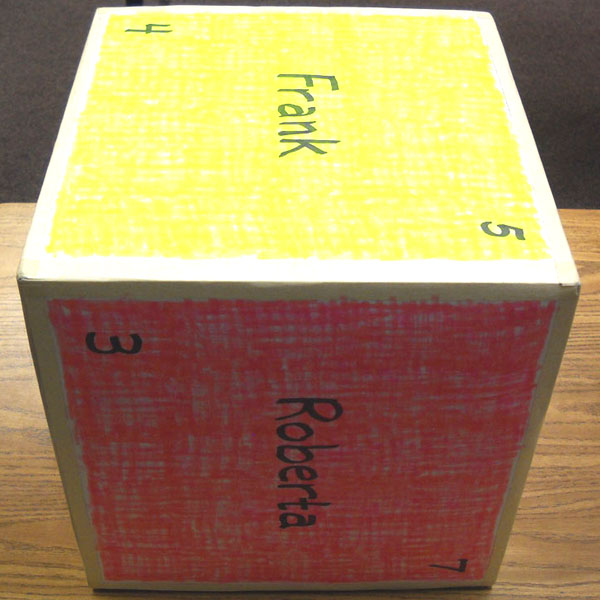
Look at the images below and record your observations of The Cube.
|
|
| (click on a picture below for a larger image) |
side one (front) |
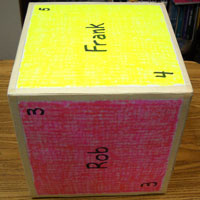
side two (left) |
| |
|
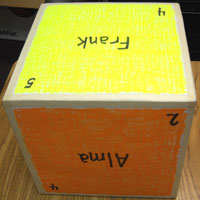
side three (back)
|
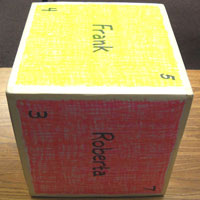
side four (right) |
| |
|
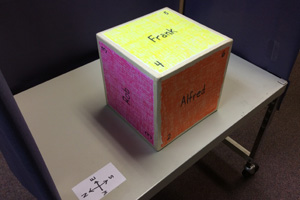
left angle (no closeup)
|
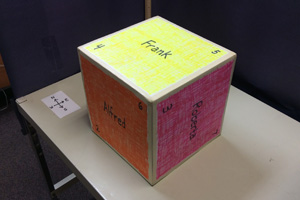
right angle (no closeup) |
|
2) Scientific question:
What question do you have about the cube? ... How about: "What's on the bottom of The Cube?"
3) Research:
Background information regarding the cube: 1) The inside of the cube is inaccessible. 2) The cube can not be touched during the observational phase. 3) The cube cannot be turned over. 4) Only ONE of the the lower corners of The Cube can be examined by sliding it to the edge of the table. You will need to decide which corner to view.
4) Hypothesis:
Write a hypothesis regarding what you expect to find on the lower corner of The Cube. Your hypothesis must include a manipulated variable (which corner you will examine) and responding variable (what you expect to find) and a reason for your prediction. Your prediction should include two (2) characteristics of the cube you might expect to find.
|
|
5a) Design an experiment:
a) identify the corner you wish to examine [suggestions: 1) How do we identify street corners? or 2) the orientation of the cube, looking at th side one (front) image in the above photos, left = N, top = E, right = S, bottom = W]
b) describe the steps that would need to be followed in order for someone else to repeat (verify) your findings
c) indicate in your experimental design that your observations will be "recorded"
d) include a method for organizing and displaying your observations (a table or diagram?)
5b) Conduct the investigation & record results
a) Contact the teacher for an image of the corner you wish to examine. (See suggestions above under Design an experiment, step a)
b) record the results of the inquiry
|
|
6) Organize & analyze data
a) examine the data looking for patterns or trends
b) develop summary of project results (include beginning & ending conditions & values; describe changes that occurred as a result of the manipulated variable)
c) use labeled table or diagram to summize results
|
|
7) Conclusion:
a) restate the hypothesis
b) indicate whether or not the investigation (results) supported the hypothesis [your conclusion regarding the investigation]
c) restate key data/observations; connect to your conclusion using “explanatory” language
Discussion (include at least two of the following):
d) evaluate effectiveness of the investigation; identify possible sources of error
e) suggestions for future inquiry or followup investigations based on results [compare results with other teams?]
f)
describe one thing you learned and how it apples to real-life situation
|
|
8) Lab Report:
Lab Title | Your Name | Class-Period | Date
- Question being investigated
- Research - preliminary observations (enough to form hypothesis; background information & limitations
- Hypothesis - predicted outcome which includes the manipulated ("if") & responding ("then") variables; brief statement of reasoning ("because") that supports your prediction [do not change hypothesis later to support your results]
- Materials - list of items needed to complete investigation (for this lab, it's primarily the "human robot" (TeacherBot) moving "The Cube")
- Procedures - step-by-step process for completing a test of the hypothesis (include: "rotate..." direction & amount; "slide" or "move" direction & amount); use complete sentences; steps may be numbered; include a statement to "observe & record" the results; may include a labeled diagram or a table to record results
- Data Analysis - organize the data and analyze for discernable patterns or relationships; describe the results ("Just the facts!"); may refer to the completed table or diagram (in procedures) or a new chart
- Conclusion - (paragraph #1) restate the hypothesis; restate the relevant data; describe HOW the results support/contradict your hypothesis
(paragraph #2) discussion of the investigation (see step # 7 above) - suggestions for future inquiry or follow up; what was learned?; include two ways The Cube activity demonstrates the"nature of inquiry" (pg. 20 of "The Nature of Science ..." textbook)
|
|
|
Created by M. Clapp
CAM 7/8 Science - BGSD
updated: 10/7/15 |