|
| |
CAM 8 Science Journal |
|
(Cover) Scientist's Name
CAM 8 - Science
Period #
|
|
(p 1) (Title Page) Earth Science Journal
Name
2010 - 11
|
|
(p 2-3) Table of Contents
4-5 ... What is Science & Branches of Science
6-7 ... Science Skills
8-9 ... Science Method (Process)
10-11 ... "The Cube"
12 - 15 ... Matter to Minerals
16 - 19 ... Minerals
20 - 23 ... Rocks
24 - 25 ... PNW Geologic Timeline
26 - 27 ... Famous Volcanic Eruptions
28 - 29 ... 7 Volcanic Hazards
25 ... Magma & Lava
16 ... Bouncing Ball
26 ... Trip to the Moon
28 ... Moon Phases
30 ... The Solar System
31 ... The Sun
32 ... Mercury
33 ... Venus
34 ... Earth
35 ... Earth's Moon
36 ... Mars
37 ... Jupiter
38 ... Saturn
39 ... Uranus
40 ... Neptune
41 ... Pluto
50 ... Health/Fitness
|
|
| (pp 4-5) Science |
What is science? Write your own definition. Your definition while probably include reference to specific knowledge (such as, the natural universe) and a process for examining natural phenomenon (such as, using the scientific method)
Branches of (Natural) Science
- Physical Science
- physics - study of matter & energy
- chemistry - the composition & structure of matter
- Earth & Space Science
- geology - history & structure of the earth
- oceanology - study of the ocean
- meteorology - study of the atmosphere
- astronomy - study of the universe beyond earth
- Life Science (Biology)
- botany - study of plants
- zoology - study of animals & animal life
- ecology - interactions between organisms & their environment
- genetics - study of heredity
- Applied Sciences (applies basic science toward practical endeavors)
- medicine - diagnosing & treating disease
- engineering - application of knowledge to design, build, and maintain sturctures, machines, devices, systems, materials, and processes
|
|
(pp 6-7) Science Skills
- Observing - determining the properties of an object or event by use of the senses
- Measuring - quantitative (numeric description) using appropriate units of measurement
- Recording - document or capture observations/measurements in a timely manner (accurate & detailed)
- Classifying - grouping objects or events according to their properties
- Inferring - drawing a conclusion about a specific event based on observations and data; may include cause & effect relationships
- Predicting - anticipating consequences of a new or changed situation using past experiences & observations
- Modeling - representing the “real world” using a physical or mental model in order to understand a process or phenomenon
- Experimenting - investigating, manipulating materials, & testing hypotheses to determine results
- Communicating - using written/spoken words, graphs, tables, diagrams, and other methods, including technology, to share data & show relationships
|
|
(pp 8-9) Scientific Method
What is the scientific method?
It is a process used to find answers to questions about the world around us through careful observation and experimentation
Scientific Method (note: here are different versions with varying number of steps.)
1. Preliminary observations & experiences (needed to form a question or identify a problem)
2. Form a (scientific) question
What do you want to know? Identify the problem or question you wish to investigate. (Must be testable --results are observable, measureable, replicable)
3. Research (needed to formulate a hypothesis & design a safe experiment)
What is known about the topic? Are materials & tools available? Are there safety concerns?
4. Construct a hypothesis
- predict the answer to your question or the outcome of the experiment
- format: "if" (manipulate var.) ... "then" (responding var.) ... "because" (reason for prediction)
- specify the change you think will happen ("it will increase/decrease"); don't be vague ("it will change")
5. Design & conduct an experiment*
a) identify variables:
1) independent or manipulated (what’s changed?)
2) dependent or responding (what’s measured?)
3) controlled (what’s kept the same?)
b) define terms & determine how variables will be measured; can include labeled diagram of setup
c) include clear, logical, sequetial steps (so that others could replicate experiment)
c) specify to collect & record data (often helpful to organize in a table)
d) repeated trials (increases validity)
* follow safety procedures
6. Analyze data & draw conclusions
a) graphs may help show relationships or trends
b)
Do your observations & data support the hypothesis?
b) restate supporting data; connect to conclusions using explanatory language
c) limit conclusions to conditions of experiment; make suggestions & identify possible errors
7. Communicate Results
|
|
(pp 8-9) "The Cube" <-- select link to see activity
|
|
(pp 12 - ) Matter to Minerals
- What is matter?
- Draw a Helium atom and label the protons, neutrons, electrons, nucleus, 1st energy level (shell), and the charges for each particle
- Copy the Lithium and Carbon cells from the period table (atomic #, symbol, name, mass #); determine the number of protons, neutrons, and electrons
- What are the differences between elements, atoms, compounds, molecules, and mixtures?
- What are isotopes? What is “heavy hydrogen”?
- What are the five characteristics of minerals?
- What is a crystal?
- What is a native mineral? What are some examples?
- Are common minerals usually elements or compounds?
- What are ions?
- What’s the difference between metals and non-metals?
- What are noble gases?
- What are ionic bonds and covalent bonds?
- What are silicate minerals? Draw & label the parts of a silica tetrahedron?
- What is the chemical makeup of salt? What crystal shape does it have? What is its mineral name?
- What is the chemical composition of water? What happens to salt when it is put into water?
- What are the two most common elements in earth’s crust?
- How are diamond and graphite similar? How do they differ?
- What are four ways that minerals form?
|
|
(pp 16-19) Minerals
Identifying Minerals
inspection: color, luster, crystal shape
simplet tests:
streak, cleavage/fracture, hardness, specific gravity, acid, magnetism, taste, flourescence ...
Mineral Groups & Some Common Minerals
- silicates - quartz, feldspars, mica, talc, hornblende (amphibole), augite (pyroxine), olivine
- carbonates - calcite
- (iron) oxides - hematite, magnetite
- (iron) sulfides - pyrite, chalcopyrite
- sulfates - gypsum
- halides - halite, fluorite
- native - diamond, sulfur
|
|
(pp 20-23) Rocks
What are rocks?
Igneous rocks
Sedimentary rocks
Metamorphic rocks
Rock Cycle
|
|
(pp 24-25) Table of WA Geologic History
notes from article on Washington State geologic history |
|
(pp ) Magma & Lava
notes from chapter |
|
(pp 26 - 27) ... Famous Volcanic Eruptions
table of information on eruptions for: Eldfell, Mt. St. Helens, Kilauea, Vesuvius, Krakatau, Crater Lake, & Mt. Pinatubonotes (from textbook)
|
|
(pp 28 - 29) ... Seven Volcanic Hazards
- pyroclastic (hot ash) flows
- lahar (mud flows)
- landslide
- lava flows
- ashfall (tephra)
- volcanic gases
- tsunamis
|
|
| |
(pp ) Bouncing Ball (planning a controlled experiment)
Write in your journal:
Q. Is a ball’s bounce affected by the height from which it is dropped?
Ask yourself ...
- Is the question testable?
- What is the … manipulate variable? … responding variable? … controlled variables?
- What are some operational definitions? (type of ball, define affect on bounce, drop heights, ...)
In your journal:
- Write a hypothesis. ("If ... then ... because....")
Write up a procedure for testing your hypothesis using a table tennis (ping pong) ball which includes the following:
- materials and tools needed to perform the investigation
- logical steps to perform the investigation
- one manipulated variable - state what is intentionally changed
- one responding variable - state what is measured/observed and recorded
- two controlled variables - state at least two ways that testing & measuring are kept the same
- state how often measurements are taken and recorded
- create a table for recording your results that includes the following:
- drop height (in cm)
- bounce height (in cm)
- repeated trials (3 drops from each height)
- average bounce height
Conduct your experiment
Create a graph of your results:
- MIX (Manipulated/Independent/X-axis)
- DRY (Dependent/Responding/Y-axis)
Writing a conclusion:
- Includes:
- observations (description of data/event)
- inferences (meaning of the data/event; explanation based on evidence)
- Four Parts:
- make a clear conclusive statement (Does the data support/not support the hypothesis? Restate hypothesis.)
- give specific, relevant data to support your conclusion; including (a minimum of) …
- lowest data value
- highest data value
- Use “explanatory language” to connect supporting data to conclusion
- Discuss results (reasons for discrepancies; ways to improve experiment or followup questions; limit conclusions to the conditions present in the experiment (other conditions may have different results) ...
|
|
|
(pp ) Trip to the Moon
notes from class |
|
(pp ) Phases of the Moon
notes from class |
|
(pp ) Solar System (notes from NASA Solar System packet)
- The Sun
- Mercury
- Venus
- Earth
- Earth's Moon
- Mars
- Jupiter
- Saturn
- Uranus
- Neptune
- Pluto
|
|
(pp 50 - 53)
Health/Fitness
Components of Fitness
- Cardiorespiratory endurance - Ability of the heart, lungs, and blood vessels to use and send fuel & oxygen to the body’s tissues during long periods of activity
- Muscular endurance - Ability of the muscles to perform physical tasks over a period of time without becoming fatigued
- Muscular strength - The amount of force a muscle can exert
- Flexibility - Ability to move the joints through a full range of motion
- Body composition - All of the tissues that together make up the body; bone, muscle, skin, fat, and body organs
Fitness Skills
- Agility - Ability to change the position of your body quickly and to control your body’s movements
- Balance - The ability to keep upright posture while standing still or moving
- Coordination - The ability to use your senses together with your body parts, or to use two or more body parts together
- Power - The ability to move strenght quickly
- Reaction time - The ability to react or respond quickly to what you hear, see, or feel
- Speed - The ability to perform a movement or cover a distance in a short period of time
FITT principle
- Frequency - How often you do the activity each week
- Intensity - How hard you work at the activity per week
- Time - How long you work out at each session
- Type - Which activities you select
FITT Principles for Cardiorespiratory Endurance
- Frequency - Exercise 3-5 times per week
- Intensity - Train at 60-85% of target heart rate zone
- Male: 14/15-yr old ~ 165 bpm
- Female: 14/15-yr old ~ 127 bpm
- Time - 20-60 minutes per session
- Type - Aerobic activity that keeps heart rate within your target zone
FITT Principle for Flexibility
- Frequency - Daily stretching
- Intensity - Stretch muscles & hold beyond its normal length at a comfortable stretch
- Time - Hold stretch for 10-15 seconds with the the stretching workout lasting 15-30 minutes
- Type - Use stretches that allow the body to move through the full range of motion
|
| |
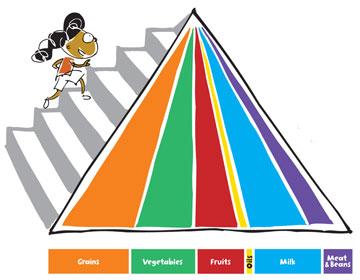
MyPyramid.gov - What does the logo represent?
-
Be physically active (teenagers: 60 min. every or most days)
-
Every color every day
-
Eat more from some food groups than others
-
Choose healthier food from each group
-
Limit your fat, sugars and salt
- One size doesn't fit all -- visit MyPyramid.gov for more information
|
|
|
Grains
-
Make half your grains whole
-
Eat at least 3 oz of whole-grain cereals, breads, rice, or pasta every day
Vegetables
Fruits
Oils
-
Make most of your fat from fish, nuts, & vegetable oils
-
Limit solid fats like butter & stick margarine
Milk
Meat & Beans
-
Go lean with protein; choose low-fat or lean meats & poultry
-
Bake it, broil it, or grill it
-
Choose more fish, beans, peas & nuts
|
| |
Questions
- Why are health & fitness important?
- What is the role of diet in maintaining health? Good examples? Bad examples?
- Why is regular exercise required to maintain fitness ? Examples?
|
| |
Concepts & Vocabulary
Nutrition |
|
- Study of foods and how they nourish the body
|
Diet |
|
- Selection of foods & drinks consumed
|
Balanced diet |
|
- Eating & drinking the right amount of nutrients to make your diet healthy
|
Body fat |
|
- The percentage of body weight that is made up of fat
|
Calorie |
|
- Unit of energy found in food
|
Calorie expenditure |
|
- Amount of calories used during daily activities & exercise
|
|
|
- Active 15 year old boy needs ~3,000 calories per day
- Active 15 year old girl needs ~2,300 calories per day
|
Health |
|
- Components include: physical, emotional, social, mental/intellectual, spiritual, and environmental
|
Physical health |
|
- The way your body functions
- Maintained through proper nutrition & sleep, regular exercise, recommended body weight
|
Physical fitness |
|
- Ability to perform daily physical activities without getting out of breath, sore, or overly tired
|
Physical activity |
|
- Movement using the larger muscles of the body
- Involves sports, dance, and activites of daily life
- Done to accomplish a task, for enjoyment, or improve physical fitness
|
Exercise |
|
- Purposeful physical activity that is planned, structured, and repetitive and improves or maintains personal fitness
|
|
|
|
Created by M. Clapp
CAM 7/8 Science - BGSD
updated: 11/12/10 |